
Newsroom · Eterna-owned guide
The Deepfake Verification Guide
What actually counts as a verified deepfake, and the standard Eterna applies before calling one confirmed.
Every week brings a new headline number about deepfake fraud: billions in losses, hundreds of thousands of victims, exponential growth. Some of these figures are solid. Others are extrapolated from small samples or vendor telemetry that measures something narrower than the headline suggests. Almost none of the coverage explains how a single incident gets confirmed as a genuine, AI-generated deepfake, as opposed to a claim that hasn't been substantiated.
That distinction is the actual work of digital identity defence, and it's the basis for the Eterna Identity Response Observatory. It's worth explaining plainly, because if Eterna is going to ask anyone to trust a verification call, the method behind it should be visible.
The scale problem, honestly stated
The data that exists is genuinely significant, even accounting for measurement caveats. One 2025 aggregation of verified incidents documented more than $1.28 billion in confirmed deepfake-related fraud losses across 1,567 verified cases, and noted that over 80% of reported incidents disclosed no financial figure at all, meaning the real total is almost certainly higher. A separate first-half-2026 review of news-reported attacks identified 821 verified incidents drawn from 1,760 news reports, with at least 15,736 documented victims. On the identity-verification side, a 2026 report covering more than a billion verification events across 195 countries found deepfakes present in roughly one in five biometric fraud attempts.
Those figures share something important: each traces back to a named methodology and a defined sample. That's the bar. A lot of circulating "deepfake statistics" content doesn't clear it; numbers get repeated across posts until the original caveat disappears.
Why human detection can't be the backstop
It's tempting to assume a trained eye can catch what a headline can't. Published research says otherwise: studies on human accuracy identifying high-quality deepfake video have found rates as low as 24.5%, worse than a coin flip. Automated detectors fare better in controlled conditions, but independent real-world benchmarking (the Deepfake-Eval-2024 benchmark) found detector accuracy dropped by roughly 45 to 50% outside lab conditions compared to curated test sets.
The standard: four tests before "verified"
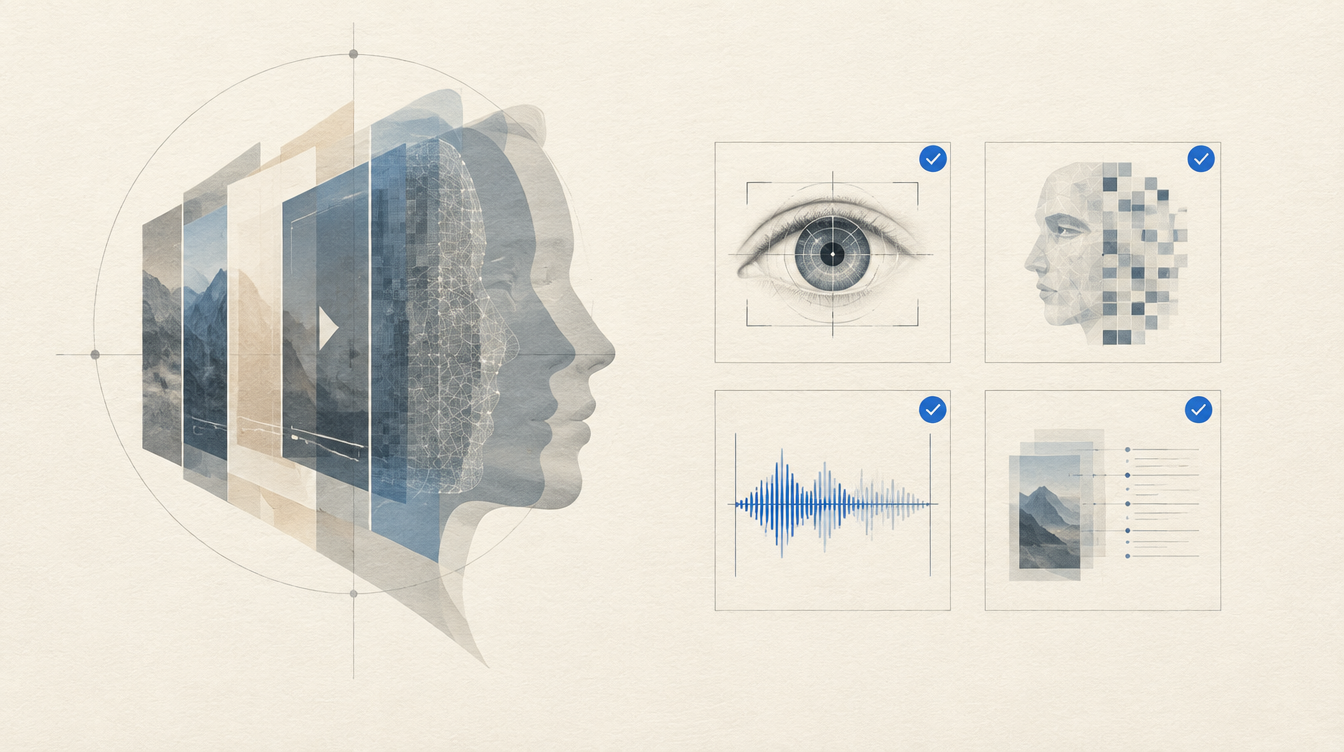
An incident earns a verified tag in Eterna's own case review (and in the Identity Response Observatory) only when it clears four checks. The full standard, with each test explained, is published on the Methodology page: sourced to a checkable origin, corroborated by an independent second signal, attributable to a stated verification method, and (where an active response is involved) authorized by the affected party before anything is escalated.
Anything that doesn't clear all four is labeled visibly as reported but unconfirmed, or disputed, not quietly dropped.
Why this matters more than another accuracy score
The deepfake-defence category has largely competed on detection speed and confidence scores. Those are useful signals, but they answer the wrong question for someone whose identity has just been weaponized. The real question is whether something can be substantiated well enough that a platform, a newsroom or a court will act on it: a documentation and verification question, not a model-accuracy question. If you're responding to a live incident right now, see the Impersonation Response Guide for the full response process, or the Executive First Hour Response Playbook for a condensed first move, or Eterna's full Deepfake Protection framework for how detection, verification and response fit together.
Sources
- DeepStrike, "Deepfake Statistics 2026," aggregating Resemble AI (H1 2026 incident data), Pindrop (voice-clone telemetry), Entrust (2026 Identity Fraud Report) and the Deepfake-Eval-2024 benchmark.
- Entrust, 2026 Identity Fraud Report.
Figures above are cited via a secondary aggregation source; Eterna is working to cite each primary report directly in a future revision of this guide.